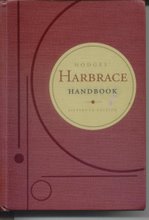
Since it was first published in 1941, the Harbrace College Handbook has gone into 15 editions, plus a CD version. Throughout the Depression, University of Tennessee Professor John C. Hodges kept files of writing errors made in his rigorous freshman English classes, eventually leading him to assemble his logically numbered set of rules. Though Hodges died in 1967, Harbrace has lived on. With input from English professors all over the nation, it has grown and improved with each edition, (and its royalties helped build the UT library, opened in 1969, that bears Hodges' name).
Still, in some cases, from one edition to the next, tiny gems of Hodges' teachings have been lost as they've been superseded by slightly different discussions. One example is from the 4th edition (1956), Rule 20a(2) Concreteness. Select the specific word instead of the vague word. The equivalent section in later editions, now numbered 20a(3), is very good. In fact, I sent it in an earlier Grammar Tip. But here, sounding the way I imagine Professor Hodges might have sounded in a classroom, is the section that was replaced:
Concreteness. Select the specific word instead of the vague word.
Avoid vague generalities. Be as specific as you can.
Instead of writing went consider the possibility of rode, walked, trudged, slouched, hobbled, sprinted. When you are tempted to say a fine young man, ask yourself whether brave, daring, plucky, vigorous, energetic, spirited, or loyal would be more appropriate. Do not be satisfied with the colorless ask when you can choose among beg, pray, entreat, beseech, implore. The word try is ineffective in most situations when struggle, fight, battle, strive are available.
The test for the specific word is contained in six words--who, what, when, where, how, why. Notice how the following sentences are improved by asking the questions Who? What? When? Where? How? Why? about one or more elements in the sentence.
VAGUE The Dean spoke about student life and that sort of thing. [Who spoke about what?]
IMPROVED Dean Jones spoke about the social advantages of the student union.
VAGUE Mr brother is going away to have a good time. [Where is he going? How will he have a good time?]
IMPROVED My brother is going to Gatlinburg in the Smoky Mountains, where he plans to fish and hunt for a few weeks.
VAGUE All the columnists are commenting on the high cost of living. [Who are commenting? Where did comment appear?]
IMPROVED In the July 12 issue of the New York Herald Tribune, Walter Lippman, George Sokolsky, and Robert Roark discussed the recent advance in food prices.
VAGUE The Army team finally advanced the ball. [How did they do it?]
IMPROVED Adams, the Army quarterback, received the ball from center Jim Hawkins, retreated to his twn-yard line, and threw a pass to left-end Smith, who was tackled on the Army thirty-five yard line.
VAGUE I think the speech was biased. [Why?]
IMPROVED Mr. Jones began his speech without any attempt to support his statement that the policies of the Republican administration were a "total denial of the American way of life."
Still, in some cases, from one edition to the next, tiny gems of Hodges' teachings have been lost as they've been superseded by slightly different discussions. One example is from the 4th edition (1956), Rule 20a(2) Concreteness. Select the specific word instead of the vague word. The equivalent section in later editions, now numbered 20a(3), is very good. In fact, I sent it in an earlier Grammar Tip. But here, sounding the way I imagine Professor Hodges might have sounded in a classroom, is the section that was replaced:
Concreteness. Select the specific word instead of the vague word.
Avoid vague generalities. Be as specific as you can.
Instead of writing went consider the possibility of rode, walked, trudged, slouched, hobbled, sprinted. When you are tempted to say a fine young man, ask yourself whether brave, daring, plucky, vigorous, energetic, spirited, or loyal would be more appropriate. Do not be satisfied with the colorless ask when you can choose among beg, pray, entreat, beseech, implore. The word try is ineffective in most situations when struggle, fight, battle, strive are available.
The test for the specific word is contained in six words--who, what, when, where, how, why. Notice how the following sentences are improved by asking the questions Who? What? When? Where? How? Why? about one or more elements in the sentence.
VAGUE The Dean spoke about student life and that sort of thing. [Who spoke about what?]
IMPROVED Dean Jones spoke about the social advantages of the student union.
VAGUE Mr brother is going away to have a good time. [Where is he going? How will he have a good time?]
IMPROVED My brother is going to Gatlinburg in the Smoky Mountains, where he plans to fish and hunt for a few weeks.
VAGUE All the columnists are commenting on the high cost of living. [Who are commenting? Where did comment appear?]
IMPROVED In the July 12 issue of the New York Herald Tribune, Walter Lippman, George Sokolsky, and Robert Roark discussed the recent advance in food prices.
VAGUE The Army team finally advanced the ball. [How did they do it?]
IMPROVED Adams, the Army quarterback, received the ball from center Jim Hawkins, retreated to his twn-yard line, and threw a pass to left-end Smith, who was tackled on the Army thirty-five yard line.
VAGUE I think the speech was biased. [Why?]
IMPROVED Mr. Jones began his speech without any attempt to support his statement that the policies of the Republican administration were a "total denial of the American way of life."