from www.wordsmith.org
obstreperous
PRONUNCIATION: (ob-STREP-uhr-uhs)
MEANING: adjective: Noisy or unruly.
ETYMOLOGY: From Latin obstreperus (clamorous), from ob- (against) + strepere (to make a noise).
USAGE: "One email informs me of a friend's trepidation at having to undergo a stress test as recommended by her physician. And she is not referring to the stress associated with the presence of recalcitrant children and an obstreperous spouse." Vanaja Rao; That Sick Feeling; Gulf News (United Arab Emirates); Feb 5, 2009.
Tuesday, March 10, 2009

Pesky IIism and word choice in one!
 Part of the following sentence is underlined; beneath the sentence are five ways of phrasing the underlined material. Select the option that produces the best sentence. If you think the original phrasing produces a better sentence than any of the alternatives, select choice A.
For both his shorter and longer works of fiction, Gabriel García Márquez achieves the rare feat of being accessible to the common reader while satisfying the most demanding of sophisticated critics.
Select the specific word instead of the vague one

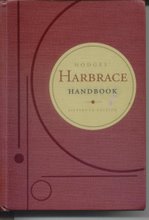
Since it was first published in 1941, the Harbrace College Handbook has gone into 16 editions, plus a CD version.
Throughout the Depression, University of Tennessee Professor John C. Hodges kept files of writing errors made in his rigorous freshman English classes, eventually leading him to assemble his logically numbered set of rules. Though Hodges died in 1967, Harbrace has lived on.
With input from English professors all over the nation, it has grown and improved with each edition, (and its royalties helped build the UT library, opened in 1969, that bears Hodges' name).
Still, in some cases, from one edition to the next, tiny gems of Hodges' teachings have been lost as they've been superseded by slightly different discussions.
Still, in some cases, from one edition to the next, tiny gems of Hodges' teachings have been lost as they've been superseded by slightly different discussions.
One example is from the 4th edition (1956), Rule 20a(2) Concreteness. Select the specific word instead of the vague word. The equivalent section in later editions, now numbered 20a(3), is very good, and I've included it below.
But first, sounding the way I imagine Professor Hodges might have sounded in a classroom, is the section that was replaced:
Concreteness. Select the specific word instead of the vague word.
Avoid vague generalities. Be as specific as you can.
Instead of writing went, consider the possibility of rode, walked, trudged, slouched, hobbled, sprinted. When you are tempted to say a fine young man, ask yourself whether brave, daring, plucky, vigorous, energetic, spirited, or loyal would be more appropriate. Do not be satisfied with the colorless ask when you can choose among beg, pray, entreat, beseech, implore. The word try is ineffective in most situations when struggle, fight, battle, strive are available.
Concreteness. Select the specific word instead of the vague word.
Avoid vague generalities. Be as specific as you can.
Instead of writing went, consider the possibility of rode, walked, trudged, slouched, hobbled, sprinted. When you are tempted to say a fine young man, ask yourself whether brave, daring, plucky, vigorous, energetic, spirited, or loyal would be more appropriate. Do not be satisfied with the colorless ask when you can choose among beg, pray, entreat, beseech, implore. The word try is ineffective in most situations when struggle, fight, battle, strive are available.
The test for the specific word is contained in six words--who, what, when, where, how, why.
Notice how the following sentences are improved by asking the questions Who? What? When? Where? How? Why? about one or more elements in the sentence.
VAGUE The Dean spoke about student life and that sort of thing. [Who spoke about what?]
IMPROVED Dean Jones spoke about the social advantages of the student union.
VAGUE Mr brother is going away to have a good time. [Where is he going? How will he have a good time?]
IMPROVED My brother is going to Gatlinburg in the Smoky Mountains, where he plans to fish and hunt for a few weeks.
VAGUE All the columnists are commenting on the high cost of living. [Who are commenting? Where did comment appear?]
IMPROVED In the July 12 issue of the New York Herald Tribune, Walter Lippman, George Sokolsky, and Robert Roark discussed the recent advance in food prices.
VAGUE The Army team finally advanced the ball. [How did they do it?]
IMPROVED Adams, the Army quarterback, received the ball from center Jim Hawkins, retreated to his ten-yard line, and threw a pass to left-end Smith, who was tackled on the Army thirty-five yard line.
VAGUE I think the speech was biased. [Why?]
IMPROVED Mr. Jones began his speech without any attempt to support his statement that the policies of the Republican administration were a "total denial of the American way of life."
Harbrace Chapter 20: Exactness begins with the heading, "Choose words that are exact, idiomatic and fresh."
Rule 20a (3) reads:
Choose a specific and concrete word rather than a general and abstract one.
General . . . Specific . . . More Specific . . . Even More Specific
food . . . . . . fast food . . . pizza . . . . . . . . . . Papa John's
prose . . . . . . fiction . . . . short stories . . . . .The O Henry Reader
place . . . . . . city . . . . . Knoxville . . . . . . . on Bearden Hill
The two pages under Rule 20a(3) are well worth reviewing, and they will serve any writer well as he or she strives to liven up and hone a story, article or paper.
VAGUE The Dean spoke about student life and that sort of thing. [Who spoke about what?]
IMPROVED Dean Jones spoke about the social advantages of the student union.
VAGUE Mr brother is going away to have a good time. [Where is he going? How will he have a good time?]
IMPROVED My brother is going to Gatlinburg in the Smoky Mountains, where he plans to fish and hunt for a few weeks.
VAGUE All the columnists are commenting on the high cost of living. [Who are commenting? Where did comment appear?]
IMPROVED In the July 12 issue of the New York Herald Tribune, Walter Lippman, George Sokolsky, and Robert Roark discussed the recent advance in food prices.
VAGUE The Army team finally advanced the ball. [How did they do it?]
IMPROVED Adams, the Army quarterback, received the ball from center Jim Hawkins, retreated to his ten-yard line, and threw a pass to left-end Smith, who was tackled on the Army thirty-five yard line.
VAGUE I think the speech was biased. [Why?]
IMPROVED Mr. Jones began his speech without any attempt to support his statement that the policies of the Republican administration were a "total denial of the American way of life."
Harbrace Chapter 20: Exactness begins with the heading, "Choose words that are exact, idiomatic and fresh."
Rule 20a (3) reads:
Choose a specific and concrete word rather than a general and abstract one.
General . . . Specific . . . More Specific . . . Even More Specific
food . . . . . . fast food . . . pizza . . . . . . . . . . Papa John's
prose . . . . . . fiction . . . . short stories . . . . .The O Henry Reader
place . . . . . . city . . . . . Knoxville . . . . . . . on Bearden Hill
The two pages under Rule 20a(3) are well worth reviewing, and they will serve any writer well as he or she strives to liven up and hone a story, article or paper.
In a daily newspaper, many stories are written on such tight deadlines that reporters may not have time to fill in many specific facts. Nevertheless, if you are reporting a story, make it a habit to ask for specifics, even when they seem unimportant.
Often your editor will ask these same questions, and it's best to know the answers. An athlete was injured. What injury? Which knee, left or right? A person was driving a car-- what model? year? what color? Someone played in a band. What was the name of the band? Who else was in it? What songs/type of music did they play?
If you're writing a feature or profile, these specifics often lead to revealing or illuminating information or anecdotes.
If you're writing a feature or profile, these specifics often lead to revealing or illuminating information or anecdotes.
Tuesday, March 3, 2009
Canard -- quackery, of sorts
from www.wordsmith.org
canard
PRONUNCIATION:(kuh-NAHRD)
MEANING: noun:1. A deliberately misleading story; hoax.2. An airplane with small forward wings mounted in front of the main wings; also such a wing.
ETYMOLOGY: From French, literally a duck. The term is said to have come from the French expression vendre un canard à moitié (to half-sell a duck, or to take in or swindle).
USAGE: "Lyndon Johnson's half-truths about the Gulf of Tonkin, supported by subservient media, embroiled the United States in a nasty war that took the lives of millions of souls. Ultimately, the Vietnam War's distortions and canards prevented him from running for a second term."Mansour El-Kikhia; Realists Conquer Politics With Lies; San Antonio Express-News; Nov 28, 2003.
"Like that old canard that George Harrison's songwriting didn't take off until Something." --Stephen Gibson 2/27/09
canard
PRONUNCIATION:(kuh-NAHRD)
MEANING: noun:1. A deliberately misleading story; hoax.2. An airplane with small forward wings mounted in front of the main wings; also such a wing.
ETYMOLOGY: From French, literally a duck. The term is said to have come from the French expression vendre un canard à moitié (to half-sell a duck, or to take in or swindle).
USAGE: "Lyndon Johnson's half-truths about the Gulf of Tonkin, supported by subservient media, embroiled the United States in a nasty war that took the lives of millions of souls. Ultimately, the Vietnam War's distortions and canards prevented him from running for a second term."Mansour El-Kikhia; Realists Conquer Politics With Lies; San Antonio Express-News; Nov 28, 2003.
"Like that old canard that George Harrison's songwriting didn't take off until Something." --Stephen Gibson 2/27/09
Right verb for millions
 Grammar Gremlins
 By Don K. Ferguson
All the news about the economy has money on the minds of readers.
Here's a recent question posed to "Grammar Gremlins":
"Which is correct, $4.5 million has or have been raised?"
Here's a recent question posed to "Grammar Gremlins":
"Which is correct, $4.5 million has or have been raised?"
The Associated Press Stylebook says for specified amounts, a singular verb is called for. Therefore, "has" would be correct in the reader's example.
When the money being referred to represents a number of individual units, a plural verb is necessary. Example: Millions of dollars have been spent already.
to the manner born
 From Garner's Usage Tip of the Day
 to the manner born
This Shakespearean phrase -- meaning "accustomed from birth to a certain habit or custom" -- first occurred in Hamlet (1603), when the melancholy protagonist bemoans the king's drunken revelry:
"Though I am a native here
And to the manner born, it is a custom
More honored in the breach than the observance."
The phrase is sometimes misunderstood as "to the manor born." But confusion in the popular mind was aggravated by a clever pun in the title to the BBC television series, To the Manor Born (1979-1981), which ran frequently on American PBS stations.
The actress Penelope Keith played an heiress who, having lived her entire life on an English manor that has been in the family for generations, is forced, through financial straits, to sell the manor to a supermarket magnate. After she moves into a smaller house on the manor, the heiress and the businessman gradually fall in love and eventually marry.
Yet, as one linguist has observed in reference to similar phrases, "what one generation says in game the next generation takes in earnest." John Algeo, "Editor's Note," 54 Am. Speech 240 (1979).
What begins as a pun can spread into genuine linguistic confusion -- e.g.: "If you were not to the manor [read manner] born, consider staying at a hotel where a guest can feel like a country squire." Barrett J. Brunsman, "Virginia's Vintages," Cincinnati Enquirer, 18 Mar. 2001.
Like, whatever
 A good SAT Question of the Day:
Part of the following sentence is underlined; beneath the sentence are five ways of phrasing the underlined material. Select the option that produces the best sentence. If you think the original phrasing produces a better sentence than any of the alternatives, select choice A.
Like machinery was integral to the development of industrial capitalism, so the rapid transfer of information is the force driving modern business.
Subscribe to:
Posts (Atom)