Monday, April 18, 2022

The Great Hoskins Art Heist


By Brooks Clark

In the darkest hours of a sticky night in August 1973, no one on White Avenue noticed a stealthy figure crawling through a basement window of Hoskins Library. Inside, the intruder pried the lock off the door to the circulation department and went directly to two boxes, where they found a total of $102 and the master keys to the building. The burglar and accomplices then made their way to the top floor of the tower, which had been built in 1932 to house the collection of oriental and Turkish rugs, jewelry, sculptures, paintings, and Renaissance furniture—some 400 pieces in all—and several thousand volumes of art and travel literature that Louis and Eleanor Audigier had accumulated during 20 years living in Rome and donated to UT.

Louis Bailely Audigier had been born in 1858 in Switzerland and emigrated to Searcy, Arkansas, where he became a newspaper editor and publisher. In 1887, he married Eleanor Deane Swan of Knoxville. They first lived in Little Rock, Arkansas, where Audigier wrote for the Arkansas Gazette, then moved to Knoxville, where Audigier was a book printer and worked in various capacities on a monthly, The Industrious Hen, serving the poultry industry. 


Eleanor was an artist, active in the Ossoli Circle, who helped organize the Knoxville Art League. The Audigiers lived in an elegant house called Crescent Bluff at 3100 Kingston Pike. In 1911, they traveled for two years in Greece, Egypt, and Palestine, then settled in Rome, where Louis took photos for the New York Times, including portraits of Mussolini and a Pope Pius XI, published several books of his pictures of Rome, traveled and lectured. Eleanor, meanwhile, collected all manners of art, originals and copies, old and new. She died in 1931, and was buried in Knoxville. After Louis remarried in 1933, he gave Eleanor’s art collection to UT in her memory. In 1936, Louis and his new bride returned to Knoxville and settled into a large Victorian home on East Magnolia Avenue. He died in 1943 and was buried in Little Rock.   


In the relatively innocent era of 1973, there were no guards on duty or electronic surveillance cameras to watch over the Eleanor Deane Audigier Art Collection. The intruders came prepared: they had brought packing crates and straw packing material. They packed up some 80 objects on exhibit throughout the gallery and slipped them out the basement window. The list of the stolen goods ranged from five antique rugs and 23 sculptures to a mahogany model of a Venetian sedan chair, a brass French coffee pot from 1809, a 19th century nutmeg grater, and an Arabian dagger and scabbard. 


Since the thieves knew exactly where to find the master keys, the police assumed it was an inside job, although lie-detector tests on 50 employees revealed nothing. The larcenists may not have been art experts: they took neither the five Raphael paintings nor some of the other most valuable artwork. Nor may they have planned what to do with the goods once they had them. The pieces have never shown up in local pawn shops or on the international markets. The Knoxville Police never found any clues to lead them to the identities of the thieves. 


In 1978, the entire collection was moved to the McClung Museum, where it resides today in vault and storage rooms secured by several systems of locks, video surveillance cameras, and motion detectors. 


To this day, the Hoskins Heist remains the largest theft of art in Knoxville history and UT’s most perplexing unsolved mystery. If your great uncle has ever wondered about a remote barn or warehouse full of packing boxes, please call me at 865-310-1277.


The Scandalous Miss Evelyn Hazen


By Brooks Clark


Over the years, UT has been home to any number of “characters.” Not many of them, however, have been featured in the pages of Life magazine.


In 1914, green-eyed, raven-haired fourteen-year-old Evelyn Hazen graduated from her private girls’ school and enrolled in the University of Tennessee. The last of Alice Evelyn Mabry Hazen and Rush Strong Hazen’s three daughters, she grew up in the antebellum Victorian home at 1711 Dandridge Avenue, at the crest of Mabry’s Hill in Knoxville, with a majestic view of downtown to the west and the Tennessee River to the south. 


As a UT student, Hazen took the stage in Staub’s Theatre alongside a smooth-talking fraternity boy named Ralph Sharringhaus, the only son of a prosperous Knoxville businessman. They were engaged in 1917, but when the United States joined the war in Europe, Sharringhaus signed up for the Army and began basic training. On one of his weekend visits, Hazen fell for an old line—basically, “What does being married in the eyes of God matter when we love each other so much?” She regretted going to bed with Sharringhaus, she later claimed, finding the experience unpleasant. It also seemed to cool his ardor to marry her.


Hazen graduated in 1918 and took a job as a teacher in the Knoxville school system, eventually landing at Knoxville High School. For the next fifteen years Hazen tried to maneuver Sharringhaus to the altar. She joined him for weekends and vacations in places like New York and Asheville, alternately fending off his advances and acceding. Finally, in 1932, Sharringhaus dumped her. “There is no solution but to stop,” he wrote to her. 


After briefly contemplating killing him, Hazen decided to sue him for breach of promise. The trial, in Covington, Kentucky, made national news, especially as she testified about her humiliation as a woman betrayed and what she called Sharringhaus’s “perverted and lascivious” demands, as recounted by Jane Van Ryan in the book
The Seduction of Evelyn Hazen.  


Hazen won the case, and the jury awarded her $80,000. Life magazine ran her picture and called Sharringhaus “an ardent wooer but a laggard groom.” Even though an appeals court upheld the verdict in 1937, she never received the money, lost her job as a teacher, and never recovered her ruined reputation.


Hazen lived out her life in the house on Mabry’s Hill. In 1951, John C. Hodges, the straitlaced head of the UT English department, hired her as his administrative assistant. Wagging tongues imagined some dalliance between the tweedy Hodges and Hazen; in fact, there was never a hint of hanky-panky, and the gossip is more telling about attitudes about female sexuality at the time. After Hodges died in 1967, Hazen continued to work in the English Department, patrolling the corridors like a character out of a Tennessee Williams play, carrying a loaded pistol on campus, and doling out office supplies like Scrooge, at least according to some. She died in 1987 at eighty-eight years old after falling in her home and suffering a stroke. Her will stipulated that her home be preserved and operated as a museum, which it is today under the direction of the Hazen Museum Foundation.


Source: The Seduction of Evelyn Hazen, available from UT Press, tiny.utk.edu/hazen 


Monday, December 14, 2020

Ken Medaris (1950-2020): An Improbable Life that Linked Weightlifting, Pro Wrestling, and "The Barn Dance" cable show

Back before spandexed multitudes swarmed tony places like Court South, Curves, and the Rush, before “personal training” was a profession, when the Downtown YMCA’s cinderblock basement weight room was known as “The Dungeon”—a few of Knoxville’s well-heeled doctors and businessmen discovered they could improve their strength and bodies by training under a former Sheriff’s department supervisor and pro wrestler named Ken Medaris. 
 
Ken Medaris (right) with pro wrestler Barry Windham    

   “Some people fish. Some people collect stamps. I love weightlifting,” said Medaris, a former 135-pound weakling who liked to say that he learned his bodybuilding techniques from a succession of experts who fortune placed in his path, each of whom had studied under one of the biggest names in the field. Under examination, this turned out to be true. 
     “He was not a bullshitter,” says Mark Hill, a local headhunter who trained with Medaris for several years. “He was such a colorful character and an interesting man.” From connections made training—mostly in the Dungeon—Medaris spent five years on the pro wrestling circuit body-slamming colleagues like the Mongolian Stomper, Klondike Bill, Professor Malenko, the Suicide Blond, and the Iron Sheik. “The best time of my life,” said Medaris. “We were stars. When we went through the Atlanta airport, we’d have to stop and give autographs.” Later, Medaris danced for five years on the Bagwell Communications cable show The Barn Dance. In real life, he worked for 16 years as a Knox County Sheriff’s Department officer and supervisor. 
     “He came from that old-school era of training,” says Clayton Bryant, former owner of Total Fitness, where Medaris trained clients starting in the mid-90s. “Back then weightlifting was a little more of a cult thing. It wasn’t as popular or widespread as it is now. It was a lot of bodybuilders, basic weightlifters, and wrestlers. For so long, athletes in other sports thought weights would take away flexibility or quickness. Now all athletes do it. Heck, even swimmers do it.” “He was Old School, but he was good old school,” says Hill. “He was smart about training. He knew. He didn’t let you hurt yourself and he was conscientious about form. Many people may not realize that he was a sensitive and deeply caring man.” 

Tiny Long Makes a Difference
In the summer of 1960, Ken Medaris was 10 and painfully shy. He was especially embarrassed that his legs looked like pencils. “I was always athletic,” said Medaris, “but I was always small. I was so skinny that it really had an effect on me psychologically. I wouldn’t go to McDonald’s to get a hamburger.” At a Saturday morning class at the Downtown Y, a 21-year-old counselor named David “Tiny” Long gave young Ken some tips. 
    “He took the time to teach me how to improve,” said Medaris. “He showed me how to sprint and told me to pick a mark on my street and run to it, then go a little further every day. He showed me how to do a lay-up and shoot a basketball, make a softball throw, do a broad jump. He told me to build a pull-up bar and do as many pull-ups as I could twice a day.” 
     At the end-of-summer decathlon, skinny Ken won top honors for Knoxville. “This is the possession I’m proudest of in the world,” he said, showing off a tiny gold award on a gold chain reading YMCA Athletic Achievement. “It was presented by John Duncan, the mayor. Jimmy Duncan was in my class, even though he was three years older.” “Tiny kindled my interest to build my body,” said Medaris. “He sent me on the road and had more influence than anything in my life.” 
     Medaris was born on December 30, 1950, in Knoxville, and lived for many years in the house he grew up in, on Lamour Ave., just off Hollywood Rd., near Pond Gap Elementary. His father, Paul, was a KUB lineman for 34 years. His mother, Hazel, worked in the cosmetics department at Miller’s Department Store. Ken moved back in to the family house take care of his dad in the 90s. “I played Midget football,” said Medaris, “but I was a tackling dummy.” His athletic career ended when he took a paper route at 13—but he did wrestle. Mr. Bowman of the Bowman Hat Company would stage impromptu wrestling matches among the kids and give a dime to the winner. “You can say that I did wrestle for a dime!” said Medaris. 

An Entrée to the Secrets of Pumping Iron
     After graduating from West High School in 1969, Medaris started at Hiwassee College. On Jan. 3, 1970, he walked into the weight room. The barbells were pipes with cans filled with cement at either end. The pulldowns were made of pulley and ropes from the hardware store. There, by what he calls a stroke of luck, the 6’1”, 135-pound string bean met a Brazilian named Evandro Camera who had apparently been carved from marble by Michelangelo. “He was five-eight and 220 pounds of solid muscle,” said Medaris. “I consider this the day I started.” 
     Back in Recife, Brazil, Camera had read all the magazines and learned about the top names in bodybuilding—especially the great Bill Pearl. Camera had embarked on a pilgrimage to Muscle Beach—Venice Beach, California—and asked, “Where is the home of Bill Pearl?” He moved into Pearl’s basement and learned the secrets of pumping iron, then earned a scholarship to Hiwassee. “We buddied up and he set out to train me and teach me what he knew,” said Medaris. “It started, as it still does, with the six sets of basic exercises: the bench press, squat, bent-over row, lat pulldowns, press behind the neck, biceps curls. I looked at all the magazines. They were baloney, other than Iron Man.” 
     Medaris trained for a year and a half with Evandro, then moved back to Knoxville and UT for one quarter in 1972. “I took a course in nutrition at UT at the Home Ec school. It was 70 women and me. Before there were protein shakes, there was Carnation Instant Breakfast. Starting then, I ate, slept, drank weightlifting. I became obsessed with only putting things in my body that would make my muscles grow.” 
      In the Dungeon, Medaris had the good fortune to get to know Bob Simpson, a commercial artist “built like a refrigerator” with a 55-inch chest who was Knoxville’s most famous weightlifter and even wrote for Iron Man. Simpson had trained under Paul Anderson, who once appeared on The Tonight Show with Johnny Carson billed as the undisputed strongest man in the world.. In 1974, “Simpson was one of the first men in America to overhead press 500 pounds,” said Medaris. Simpson did it in the YMCA. A lifter named Ken Patera did it in competition, stealing Simpson’s glory, but Medaris saw Simpson do it. He also saw Simpson partially press 820 pounds, bending a York Olympic bar double in the process. “That bent bar stayed in the Y for 20 years as a tribute.” 

Medaris watches the Stomper lift.  
Sheriff's Deputy and Pro Wrestler

      In 1974, Medaris was working part-time in a health food store when a U.S. Marshall came in—and started Medaris thinking about law enforcement. He took the test for the County Sheriff’s office and started out “at the bottom of the pole” as a process server. In a 16-year career, he worked his way up to officer and eventually supervisor. In the later 1970s, Medaris watched Southeast Champion and Smoky Mountain Wrestling legend Archie Gouldie, the Mongolian Stomper, who lived in Maynardville and East Knoxville. “He was the Stomper,” said Medaris. “It was so intimidating. For six months I was afraid to talk to him. One day I asked, ‘Could you tell me how to build my chest?’ I ended up training with him for over a year.”

The Stomper was Medaris’s entrée into professional wrestling, where Medaris was known as an “excellent worker”—meaning that he made the seasoned hands look good—and a “good hand,” meaning that he could handle the basic moves that audiences liked. “On the wrestling tour,” said Medaris, “you gotta be able to get along with people.”

    In 1981 Arnold Schwarzenegger, who had won Mr. Olympia and Mr. Universe bodybuilding titles and been featured in the documentary Pumping Iron, came to Knoxville to do a promotion for Larry Jackson’s weightlifting equipment. 
     Medaris sat next to him at dinner at Jackson’s house. “We were the same height, 6’ 1”, and weighed exactly the same, 215. But my arms looked like spaghetti noodles next to his. I thought, how is that possible? He told me, ‘It’s 50 percent what you do in the gym and 50 percent what you put in your mouth.’ He told everybody he was on his way to Hollywood to make movies. Everybody said, ‘You’re on your way to the poorhouse—that’s where old weightlifters go.’”                     
      Medaris wrestled for five years and was always paid in cash. In 1983, he suffered a serious back injury, rupturing a couple of discs and ending his ring career. “It put me out of business.” Then came The Barn Dance at Bagwell Communications, which was then pioneering the production of shows to fill the vast expanses of cable TV. Medaris danced on 800 shows with Amanda Maples, now marketing director of the Sevierville Chamber of Commerce. Medaris met and befriended the original three Dixie Chicks (below), especially Laura Lynch, who was eventually Pete Bested in favor of Natalie Maines. 

The Accidental Personal Trainer 
      One day, in 1982, at the Knoxville downtown Y, Dr. Ray Depue said to Medaris, “I’ve been watching you, and you seem to know what you’re doing. I’ll be glad to pay you, but could you teach me how to lift weights?” “There was no such thing as a personal trainer in those days,” says Medaris. He trained Depue, which led to another client and another. He charged them $10 a session. When Depew built the Sports Farm, Medaris started training there. 
       When I-40/75 ran over the Sports Farm, Medaris moved his operations to other gyms. Around 2006, Mark Hill walked into The Gym, then owned by a former male model named David White, and asked for a trainer. “He looked me and saw that I was old and skinny,” says Hill, “and he shuffled me over to Ken. He sent the dregs to Ken.” Hill turned out to be a dedicated student who quickly doubled his strength. When The Gym ran into money problems, Hill helped Medaris set up shop at the Knoxville Racquet Club, where he trained clients for five years before his declining health led to his retirement. 
      Medaris died of various complications of heart failure on Thursday, December 3, 2020, a few weeks shy of his 70th birthday. I was lucky enough to win five training sessions with Ken Medaris at an Opera Ball auction. After those five visits to the Racquet Club, I signed up for many more and learned a regimen for the weight room that brings benefits to the present day. 
       I like to remember Ken quoting the bodybuilder John C. Grimek, known as “The Monarch of Muscledom,” who often said, “What a shame it is for a person to go through his life and not know the joy of a well-developed body.”

Tuesday, March 20, 2018

FRANK CUSHWA: A LEGACY OF PASSIONATE TEACHING AT 100

By Brooks Clark
From the Exeter Bulletin, Summer 2007

Beloved by his colleagues and students (including writers like James Agee, Robert Benchley and Robert Nathan), Frank Cushwa was “a skillful and sympathetic teacher who made a difficult subject living and thrilling.” He was also a puzzle.

One hundred years ago, Frank William Cushwa joined the Exeter faculty as an instructor in the
English department.
   At such a milestone, it’s fitting to assess Cushwa’s influence on the Academy over his 32-year
tenure. “From the moment he joined the faculty,” wrote Myron R.Williams in The Story of Phillips
Exeter, “he began arousing interests that had grown sluggish and set in motion new ones. Under
him the English Department truly came of age, and he gave new life to the Bulletin, which he
edited until 1933. The Davis Library, the Monthly, Academy lectures, funds for lectures and prizes, the Lantern Club, the Southern Club, the Musical Clubs, winter sports, new dormitories, the Art Department, the Dramatic Association, Phillips Church, the Problem Committee, the Harkness
Plan—these and other things received from him either the initial impulse or much of the momentum to make them go.”
  At the same time, the centennial of Frank Cushwa’s arrival at Exeter presents a puzzle. It’s not a puzzle we can solve, as much as we might like to, but it can perhaps draw us closer to a legacy
of innovative teaching.
  Cushwa grew up in Martinsburg, WV. He graduated from West Virginia University in 1902, got one master’s degree at WVU in 1903 and another at Harvard in 1904, then taught at Choate for
several years.
    In his first year at Exeter, Cushwa, then 26, assigned his class to write an essay on a practical subject. One student, the future humorist Robert Benchley ’08, sought out the local undertaker, who eagerly taught Benchley every gruesome detail of preparing a body for burial. Benchley’s essay nonplussed his teacher with its stomach-turning itemization of corpse-care. “Mr. Cushwa, who was young and rather shy, had a little trouble getting through it,” wrote Nathaniel Benchley ’34 in Benchley, a biography of his father.“He could not deny, however, that it was practical. He cleared his throat, wiped his glasses, and gave it an A.”
    Benchley carried his interest in embalming into his years as an Algonquin Round Table wit. He subscribed to undertakers’ trade magazines, and when he and Dorothy Parker shared an office at Vanity Fair, they decorated their walls with cadaver illustrations, which they found hilarious. When their editor told Benchley and Parker to take the pictures down, it fueled the world-
class humorists all the more.
    Benchley and Parker befriended Donald Ogden Stewart ’12, then an editor at Life. (Stewart later wrote humorous books and crafted many screenplays, including The Philadelphia Story, for which he won an Academy Award.) “One of the things which brought Robert Benchley ’08 and me together at
our first meeting 10 years later was our mutual affection for Cush,” wrote Stewart in Exeter
Remembered,a collection of essays.“A more imaginative nickname [than Cush] would have been
‘Dr. Johnson.’ He was perfect for the part. His fat body moved awkwardly; his one good eye glared
from his blotched face as he grunted out his angry judgments.We loved him. His Shakespeare
classes were the most popular in the curriculum. His student imitators (and they were legion)
could always get a laugh, but it was a sympathetic laugh.”
    Cushwa taught, inspired and instilled a love of literature and writing. “In the 1920s,” wrote
Charles Edward Wyzanski Jr. ’23 (a judge with the U.S. District Court of Boston) in Exeter
Remembered, “the Phillips Exeter Academy was the most incandescent place for a boy who was
ready for the world’s most stimulating teaching—the kind of fire that burned from Frank Cush-
wa with lightning force lit the wicks of a thousand waxen lads.”
     Cushwa was a member of the committee that created the Harkness Plan. In 1933, he published his
Introduction to Conrad,which used autobiographical passages from Conrad’s works to paint a picture of Joseph Conrad as a person and a literary craftsman. In 1936, Cushwa co-wrote, with Exeter colleague Robert N. Cunningham, Ways of Thinking and Writing, a textbook
of advanced composition that provides a window onto the passion for ideas and creative thought that made the Exeter experience unique. (Used copies of this textbook are still available through Amazon.com.)
     “Undoubtedly,” wrote Williams in The Story of Phillips Exeter, “Mr. Cushwa’s great gift was that of vitality.   He loved life himself and loved to see things live. His passion for shrubs and flowers was one example. With this love, however, went a lively sense of justice and a quick concern for the weak or the distressed. Almost best of all was his rich sense of humor, and his friends can still hear the hearty laugh that trumpeted the good joke.”
      Williams quotes a student who described Cushwa as “a skillful and sympathetic teacher who made a difficult subject living and thrilling, and an adviser of never failing wisdom and experience, a father and a companion. Patience and a sense of humor prevented him from ever
treating anyone harshly.”
    Then there is the puzzle. In the late 1930s Cushwa apparently fell into a depression—though no one in those days knew to call it that. On April 30, 1939, at age 57, Cushwa took his own life at the home of relatives in Worcester, Mass. As is often the case, no one ever really knew why, if there
was a why, or if there ever is a why. We certainly can’t escape the irony of a person who so loved life ending his own.
    While noting this mark of 100 years—and how distant it makes that era sound—we can at the same time remind ourselves that in fact it was just a generation or two ago. Frank Cushwa was my
grandfather. His son,William T. Cushwa ’36, 89, is my uncle Bill. His daughter, Charlotte Cushwa
Clark, is my mother. Now 90, Mom remembers James Agee ’28 walking through their garden behind Gilman House. “He was a very odd walker,” she says.“I didn’t know his name at the time, but I saw
pictures later and knew it was him.” Cushwa wrote in a recommendation letter for Agee, "He was meant for Harvard and Harvard for him." At one time my grandmother, Elizabeth Cushwa, had in her bookshelves a copy of Let Us Now Praise Famous Men that Agee had inscribed, “To Mr. Cushwa, who taught me everything I know.” It is somehow appropriate to Agee’s legendary status that
the book was lost after my grandmother’s death.
    None of Frank Cushwa’s 11 grandchildren—my five cousins, my five siblings and I—
were born during his lifetime. So, strictly speaking, none of us knew him. But we know his
hearty laugh. It was passed on and can be heard at any family gathering. Many other clear and discernible traits were passed on—among them love of learning, words and talking, a joy in aiding the development of young people, and, for some of us, alas, a tendency to girth. We can look around and realize that Cushwa’s passion for teaching still lives and breathes at Exeter—and some of us can realize that it lives and breathes in us.

The youngest brother of W. Tucker Clark ’63, Brooks Clark (St. Albans ’74, Dartmouth ’78) lives in
Knoxville, Tenn. 

Friday, October 27, 2017

John C. Hodges: The Harvard Scholar Whose Grammar Book Built the Library.


By Brooks Clark

 Back in the 1920s a college professor devised a system for marking essays to help his students identify their grammatical mistakes. Seventy-six years after he first published his scheme in a handbook for English instructors, his text is still an academic and commercial success. The John C. Hodges Library is named in his honor.

     John Cunyus Hodges was born March 15, 1892, in tiny Cotton Valley in northwestern Louisiana, between Shreveport and the Arkansas state line. It was a rural but comfortable childhood. At the age of 19, Hodges graduated with a BA from Meridian College in Mississippi, and he got his master’s in English from Tulane a year later.
     In 1913 Hodges became an instructor at Northwestern University, where he met Alwin Thaler, a Shakespeare scholar from Brooklyn. The genteel southerner and the German immigrant from New York became lifelong friends. At a summer program at the University of Wisconsin, Hodges met Lillian Nelson. They married in 1914.
     Thaler and Hodges started at Harvard in 1916. Hodges earned his PhD in 1918 and got a job at Ohio Wesleyan, just north of Columbus, where he taught for three years. Thaler ended up at the University of California at Berkeley.
      In 1921 Hodges was recruited to the Tennessee English department by James Douglas Bruce, a noted Celticist and Arthurian scholar, who later helped steer Hodges into his chief scholarly concern, the life and work of the Restoration playwright William Congreve. On his arrival, Hodges took over the direction and coordination of “a moribund program of Freshman English,” according to Kenneth Curry’s history of the department, English at Tennessee. Within a year, Hodges developed the beginnings of a systematic approach to teaching freshman English. Curry writes that Hodges had students keep their papers and revisions in folders, which they would discuss in regular conferences with their instructors. The folders were then archived by the department. “Over time, Hodges analyzed and tabulated the contents of these folders,” Curry explains. With so many stacks of papers and so many sets of corrections, Hodges was able to systematically determine which errors his students were most likely to make.
     In 1923 Hodges persuaded his colleagues to lure Thaler away from Berkeley. John and Lillian met Alwin and Harriett at the train station and hosted them at their house at 1908 White Avenue while Alwin looked for a house to rent. For the next four decades, Hodges and Thaler were “the Harvard guys,” as English Professor Bain Stewart put it— respected scholars and teachers who brought gravitas to the department.
         
‘All Matters Needed by Freshmen’
     Starting in 1922, Hodges published his own “Manual of Instruction for Freshman English,” which he expanded each year. By 1937, the manual was 29 pages long and included a map of the library and instructions on how to write papers.
      Hodges became assistant head of the department in 1937 and acting head between 1938 and ’41, when he formally succeeded Burke.
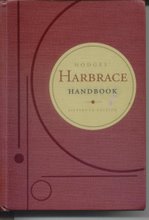
    Sometime in the late 1930s, a Harcourt Brace traveling textbook salesman named Sidney Stanley visited UT. He met Hodges, and after he heard about his system of correcting papers, he passed on the lead to the Harcourt Brace editorial department. Intrigued, the publishing company offered Hodges a contract. What Hodges called his handbook of “all matters needed by freshmen” was published in 1941. (“Harbrace” is a conflation of Harcourt Brace.)
     “The rest is history,” says Michael Rosenberg, a publisher at Wadsworth/Cengage Learning, which owns the rights to the now-defunct Harcourt Brace’s college textbooks. “The company was hoping to make only a small dent in the freshman handbook market with the unknown author from Tennessee. However, the clever organizational plan, the compact, trim size, and the book’s ability to explain difficult issues of language cogently and concisely created a demand that catapulted the handbook to best-seller status quickly.”

     Hodges had two stated objectives when he composed his textbook. The first read: “To make correction of written work as clear and easy as possible for the student.” The second was: “To make marking of student papers as easy as possible for the instructor.” The latter point—making teachers’ lives easier—has been the secret to its continuing success.
      Each broad, numbered section was subdivided in an alphanumeric scheme that aided citation. Hodges’s unique numbering of each rule enabled teachers coming upon a sentence such as “While riding a bus, the tornado ripped through town” to simply write in the margin “25f(4),” sending students to the rule “Avoid dangling elliptical phrases or clauses” and its explanation.    
       The first edition of Harbrace came out at the beginning of World War II. After it was published, Hodges embarked on a program of identifying best practices among English teachers across the state and spreading their gospel. “By collecting the scores of freshmen entering the colleges in the state of Tennessee,” wrote Kenneth Curry in English at Tennessee, “it was possible to identify the high schools with superior programs in English as well as the superior teachers of high school English. Dr. Hodges himself visited many schools and began a program that was to be expanded after the war.” 
       So, too, did Hodges expand the UT English department, which had six staff members at the end of World War II. “Hodges was a catalyst for the amazing transformation of a small, sleepy department into a lively, expanding department,” wrote Curry. “Where others in the University had been pessimistic and defeatist, Dr. Hodges was positive and hopeful and confident that, given the opportunity, the department would justify his faith.”
     A second edition of Harbrace appeared in 1946. A third followed five years later, and a fourth edition five years after that.

An Expert on the Bawdy Bard
      In his own academic research, Hodges was a leading authority on the seventeenth-century English playwright William Congreve, who hit it big with five high-brow, sexual comedies of manners written between 1693 and 1700. This was during the roaring Restoration Period, when the rakish Charles II had replaced the stick-in-the-mud Puritans, reinstated the Anglican Church, reopened the theatres, and allowed women (including his own mistress, Nell Gwyn) to perform on stage.    
    Congreve’s plays included memorable lines such as, “Heaven has no rage like love to hatred turned, nor hell a fury like a woman scorned,” “Music has charms to sooth a savage breast, to soften rocks, or bend a knotted oak,” and “Say what you will, 'tis better to be left than never to have been loved.”
      The dawn of the 1700s brought a conservative reaction to the Roaring 1690s. A wave of button-down mores swept England, Congreve’s bawdy style fell out of fashion, and Congreve turned thereafter to politics of the Whig party.
     Over the years, Hodges amassed one of the world’s largest collections of Congreve’s plays, which are now housed in UT’s Special Collections. In the late ’40s, Lillian accompanied Hodges to England and Ireland to help him collect material for his book The Life of Congreve.
     In the late spring of 1951, Lillian grew ill. Still, she accompanied Hodges on a trip to the Huntington Library in Pasadena, California, to gather material for the book The Library of William Congreve. Unfortunately, Lillian’s condition worsened. She entered a Pasadena hospital and died a month later.
     They had one son, Nelson.          
     Hodges met Cornelia Smartt Hendley when she served as executrix of the estate of Hodges’s former colleague John B. Emperor, who had set up a fund for the English department in his will, much as Hodges did later on. “My sister had an uncanny ability to handle details and amounts,” says John Smartt, Hodges’s brother-in-law. “She had a good business head on her.”
     Cornelia and John married in 1952 and spent six months together in Europe doing Congreve research. One of their key findings resolved confusion about the authorship of the play that begins with the line, “Music has charms to soothe a savage breast.” Some manuscripts of the day attributed the play to the Duke of Leeds in Yorkshire, England, but Hodges located Congreve’s private library catalogue and verified that the lines were, in fact, his. In all, Hodges’s search for duplicates of books owned by Congreve was a four-year project that took him to libraries in five countries.
     John and Cornelia lived for fifteen years at 8 Hillvale Circle in Sequoyah Hills, where she threw elegant English department parties and displayed her lively wit. “She was whip-smart and hilariously funny, while always the genteel southern lady,” says Ginna Mashburn, a faculty spouse and instructor.

A Gift that Keeps on Giving
        In its various editions, co-authors and collaborators worked with Hodges on Harbrace, but the format stayed the same. One of the biggest changes came in the 1962 fifth edition, when Hodges’s name was added to the title, just as he retired from teaching in the English department. In July of 1967, Hodges died at 75 following a heart attack. His will left half his Harbrace royalties to the UT Libraries and the English department. Now in its eighteenth edition, Harbrace—the most successful college textbook on record--is a gift to UT that keeps on giving. 
        When the John C. Hodges Library was dedicated two years later, Cornelia helped put in place a cornerstone that to this day contains a 1969 UT yearbook, a ’69-’70 catalog, library development annual reports for 1966 to ’68, and Hodges’s three books—the sixth edition of Harbrace, The Life of Congreve, and The Library of Congreve.     

        “He was an imposing presence,” said David Burns of Knoxville, who took freshman English under Hodges in 1950 and still has his inscribed copy of the 1946 edition of Harbrace. “He wore tweed jackets most of the time, as you’d expect, and he was a grammarian through and through. I think of him when I read even magazines that have good writers and see one grammatical error after another. He was simply one of the finest gentlemen I ever knew.”


This story appeared in its current form in 30 Years of the New John C. Hodges Library (c) University of Tennessee Libraries, 2017.