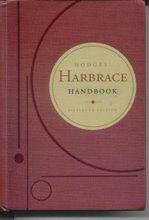
Harbrace 18b: Distinguish between words of similar sound; use the spelling required by the meaning.
Section 18b includes nice list of the Top 100 sets of Words Whose Spellings Are Frequently Confused. It also refers us to the excellent Glossary of Usage in the back (pages G-1 through G-11 marked usgl in the upper right corner).
But here are four particularly pesky homonym/homophones:
Right: "The Dow Jones Industrial Average peaked at 12,500."
Right: "The story piqued my interest."
The word pique comes from the French word piquer, to prick. Pique has several meanings: 1) to arouse anger or resentment in, or offend by slighting, 2) to excite or arouse by provocation, 3) to stir up the pride in an accomplishment.
Other homonyms (or near homonyms) that trip almost everyone up:
"I am the Marquis de Sade." (a nobleman below a duke and above an earl)
"The theater marquee said the show started at 7:00 pm." (a permanent canopy projecting over an entrance to a theater or a hotel)
"Because of the court's ruling, the lawyer's point is rendered moot." (deprived of practical significance; a great Old English word)
"After his traumas in the holocaust, the young Jerzy Kozinzki was rendered mute." (unable to speak)
"The speech was filled with wonderful anecdotes." (short, amusing stories or biographical incidents)
"After he was bitten by the snake, the adventurer called out for the antidote." (a remedy to counteract the effects of a poison)
"Ronald Reagan charmed the nation with his self-deprecating humor." (effacing; expressing mild or regretful disapproval)
"The house had somehow depreciated over the past decade." (decreased in value)
Thursday, December 6, 2007

Wednesday, December 5, 2007
Like Dorothy Parker's wit -- caustic
caustic (KAW-stik) adjective
1. Capable of burning or corroding.
2. Highly critical; sarcastic.
[From Latin causticus, from Greek kaustikos, from kaustos (combustible), from kaiein, (to burn).] Caustic soda (Sodium hydroxide) is a highly corrosive substance used in the manufacture of soap, paper, and textiles.
"Some were outright sarcastic, others clearly caustic."
-- Vijay Mruthyunjaya; ICC's Hairobics Baffle; Gulf Daily News (Bahrain); Aug 28, 2006.
An example of caustic wit:
"She runs the gamut of emotions from A to B."
-- Dorothy Parker, speaking of Katharine Hepburn
Tuesday, December 4, 2007
How to structure the SAT essay
The essay section of the SAT presents an opportunity to excel for those who are prepared. A while ago my high school alumni bulletin ran a story about its month-long SAT-prep program, directed by math teacher Linda DeBord.
In preparation for the SAT essay section, students compose two to five essays under test conditions, which Mrs. DeBord then assesses and scores.
"Learning to outline and write an essay under pressure was invaluable," said one student. "The corrected essays were also helpful, as we learned from our mistakes." (This is the same preparation done by West High teachers like Shannon Jackson, who so effectively help their students earn nice AP scores and -- as Isabel Clark attested in the August 2006 Cityview magazine -- do well in college, where almost all the tests are timed essays.)
I asked Mrs. DeBord for some tips, and she kindly replied.
Of course a student should briefly outline the essay before writing. "In the brief 25 minutes, the up-front planning is critical," says Mrs. DeBord, "but the students need to keep a careful eye on the time. I suggest that in the opening paragraph, after they state their thesis, they should mention two examples they will use. The examples should be clear in their relationship in supporting the thesis. The conclusion should restate, in an interesting way (if possible), the thesis and then re-tie in the examples."
So, the structure of the essay goes pretty much --
I. State thesis
II. Preview two supporting examples
III. Elaborate thesis
IV. Flesh out examples
V. Conclusion
a) restate thesis (interesting way)
b) re-tie in the examples
Monday, December 3, 2007
Lost Chapters of "A Death in the Family"
The other day in the Post Office I ran into U.T. English professor Michael Lofaro.
Renowned as a Daniel Boone and Davy Crockett scholar, Michael mentioned that he has recently culminated five years of editing work with the publication of A Death in the Family: A Restoration of the Author's Text (UT Press).
[Click here for a story on how Lofaro came to piece together the original manuscript.]
As Knoxvillians know, James Agee's original manuscript had been reworked by a friend of Agee's after Agee's sudden death in 1955. Four of many "lost chapters" appear in this month's Harper's under the headline "Enter the Ford."
Knoxvillians will delight in many descriptions of 1913 Knoxville, such as that of riding the open streetcar from Gay Street downtown out to Chilhowee Park for the fair, where Agee's father takes offense at an imagined slight by a carnie, which initiates a long, priceless series of whupass-type exchanges like the following:
"If you're lookin for trouble," the man said, "just say the word, cause there's plenty here that's paid to find it."
"Just if you want it," daddy said. "If you want it I'll give you all I got. You and them too. Way you talked tother Satdy you was looking for it."
The lost chapters present a new element to the novel -- that of "daddy's" new Ford as an alluring, yet ominous addition to the idyllic world of Agee's childhood. At one point Laura, the mother says, "... something dreadful is going to happen, Jay. Something irreparable. To our family. In that auto."
We also see an early example of road rage, as a speeding, honking, begoggled driver on Highland Avenue roars by a horse and buggy and then Jay's Ford, toppling the family to the side of the street, then looking back with a grin.
"Why you crazy God damn son of a bitch I like to bust yer f---- God damn jaw!" And his door was already wrenched open and one foot was out before he realized the uselessness. "I swear to God I could kill a man like that," he said. "I mean it. I could kill him and it'd be a pleasure to."
Some things haven't changed too much on Knoxville's roadways.
That "you're in trouble" stance -- arms akimbo
from www.wordsmith.org
akimbo (uh-KIM-bo) adjective With hands on hips and elbows turned outwards.
[Of uncertain origin, probably from Old Norse.]
"The goal also sent goalkeeper Bakalo Silumbu into tears, who was seen with arms akimbo and mouth agape between the goal posts."
-- Francis Tayanjah-Phiri; Chess Boss Sponsors Football Tourney; The Daily Times (Blantyre, Malawi); Nov 22
Wednesday, November 28, 2007
I Stick My Neck Out for Nobody (except to sing "La Marseillaise")

Q: What are the specific dates during which the action of Casablanca takes place?
Hint: This is a pretty good time of year to ask this question.
Grammarians seem to love Casablanca. Perhaps it's all the lines and phrases that are part of our daily vocabulary. (Whenever we say we are "shocked, shocked" to learn of some wrongdoing, we are quoting Captain Louis Renault without any need of explanation beyond a certain inflection in our voices echoing the bureaucratic hypocrisy embodied for all time so wonderfully by Claude Rains.)
A: We must be alert near the beginning of the movie, when we first meet American ex-patriot barkeep Rick Blaine as he OK's a check, dated 2 Decembre, 1941.
That evening, Ilsa Lund, the lost love of Rick's life, enters Rick's Cafe Americain with her husband, freedom fighter Victor Laszlo. After the bar closes, Rick drowns his sorrows with Sam the piano player and says, "It's December 1941 in Casablanca. I'll bet they're asleep in New York. I'll be they're asleep all over America."
On December 3, Isla and Victor check the black market for Letters of Transit. That evening at Rick's, Victor counters a group of German soldiers singing "Watch on the Rhine" by leading the band and customers in "La Marseillaise," forcing Major Strasser to close the cafe. (The tears in the customers' eyes were by-and-large real --- most of the extras were refugees from Nazi-occupied Europe, overcome by the emotion of the scene.)
Later that night, while Victor attends a meeting of the resistance, Ilsa visits Rick and ... well, the details are left to our imagination.
On Dec. 4 Rick sells his cafe to Signor Ferrari of the Blue Parrot and arranges the scheme to get Ilsa and Victor on the plane to Lisbon, which he does, killing Major Strasser in the process. Arm in arm with the cynical Captain Renault, Rick joins the fight, just three days before the rest of his countrymen do. (Which, of course, is the point of the picture, made in 1942.)
Along with shooting a Nazi major through a trench coat, every Casablanca fan yearns to be able to sing "La Marseillaise" along with Yvonne, the teary-eyed barfly. So, here are the lyrics:
Allons enfants de la patrie, . . . Arise you children of the fatherland,
Le jour de gloire est arrive. . . . The day of glory has arrived.
Contre nous de la tyrannie . . . Against us the bloody flag
L'etendard sanglant est leve. . . . of tyranny is raised.
Entendez-vous dans les campagnes, . . . Do you hear in the fields,
Mugir ces feroces soldats? . . . The howls of these ferocious soldiers?
Ils viennent jusque dans nos bras . . . They come right up into our arms
Egorger vos fils, vos compagnes: . . . To slit the throats of your sons, your comrades.
Aux armes, Citoyens! . . . To arms, citizens!
Formez vos battailons, . . . Form your battalions.
Marchons, marchons, . . . Let's march! Let's march!
Qu'un sang impur . . . Let impure blood
Abreuve nos sillons! . . . Water our furrows!
Several years ago, Anne Bagamery, business editor of the International Herald Tribune in Paris, wrote about a political controversy then taking place about the last two lines of "La Marseillaise":
"Most people think they are 'Que sang impur abreuve nos sillons' -- in other words, let the blood of our enemies fill our furrows. Others, including the ultra-right National Front, insist the words are "...n'abreuve nos sillons" -- let the blood of our enemies NOT fill our furrows, in other words, keep the filthy interlopers off our land entirely. Members of that party often sing their own version of the lyrics, despite what everyone else is singing.
"Also BTW, and I did not know this until I had a child in French school: French people do not systematically learn their national anthem! If you watch closely during big ceremonies, you'll see that even high government officials are not singing along. This is not because they fear they will break down with emotion; it is because they don't know the words!"
And they don't watch Casablanca the way we do!
Tuesday, November 27, 2007
Your and you're; its and it's
"Thank you."
"Your welcome." Aaiiiieeeee! Please kill me now.
This is an error that seems to be an epidemic at all levels of society, especially on e-mails.
"Your welcome." Aaiiiieeeee! Please kill me now.
This is an error that seems to be an epidemic at all levels of society, especially on e-mails.
- "You're" is a contraction of "you are."
- "Your" modifies nouns, and in "your house."
- "It's" is a contraction of "it is," as in, "It's a beautiful morning."
- "Its" is used to modify nouns, as in, "The cat uses its litter box."
These and other common confusions are listed in Harbrace's Glossary of Usage, (G-1 through G-11, near the back, marked usgl on the upper right corner of the right-hand pages.
Subscribe to:
Posts (Atom)