from www.wordsmith.org
vomitorium (vom-i-TOR-ee-uhm) noun, plural vomitoria .
A passageway to the rows of seats in a theater.
[From Latin vomitorium, from vomere (to discharge).]
Vomitoria in ancient amphitheaters helped the audience reach their seats quickly and then, at the end of the performance, leave at an equal speed (hence the name). Thousands of seats could be filled in minutes. The suggestion that a vomitorium was the place for the ancient Romans to vomit during a feast has no basis.
"Sarah Walters, 21, a university student, said: 'I love the fact that the exit sign at the station is now tagged as the vomitorium, it's very descriptive.'"
-- Paul Stokes; Metro Passengers Find Their Way to the Vomitorium; Daily Telegraph (London, UK); Mar 13, 2003.
Friday, May 30, 2008

Thursday, May 29, 2008
"The latter" with two, "the last" with three or more examples

From an editorial in today's New York Times:
"There are several kinds of Washington memoirs: “I Reveal the Honest Truth,” a kiss-up-and-tell designed to settle scores (nod to honesty optional). “I Was There at the Start,” designed to make the author appear to be the linchpin of history. And, most tedious: “I Knew It Was a Terrible Mistake, but I Didn’t Mention It Until I Got a Book Contract.” Scott McClellan’s memoir is the latest entry in the latter genre."
Oops! That should be "the last genre."
Rule No. 198 from Guide to Composition (1919) by Royster and Thompson:
In speaking of more than two persons or things, prefer any [one] and the last to either and the latter.
Example:
(Possible) She was smaller that either of her three sisters.
(Preferable) She was smaller than any [one] of her three sisters.
Wednesday, May 28, 2008
Choose a specific and concrete word rather than a general and abstract one.

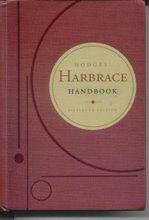
Harbrace Chapter 20: Exactness begins with the heading, "Choose words that are exact, idiomatic and fresh."
Rule 20a (3) reads:Choose a specific and concrete word rather than a general and abstract one.
General // Specific / More Specific / Even More Specific
food // fast food // pizza // //Papa John's
prose // fiction // short stories // The O Henry Reader
place // city // Knoxville // on Bearden Hill
The two pages under Rule 20a(3) are well worth reviewing, and they will serve any writer well as he or she strives to liven up and hone a story, article or paper.
In a daily newspaper, many stories are written on such tight deadlines that reporters may not have time to fill in many specific facts. Nevertheless, if you are reporting a story, make it a habit to ask for specifics, even when they seem unimportant.
Often your editor will ask these same questions, and it's best to know the answers.
An athlete was injured. What injury? Which knee, left or right?
A person was driving a car-- what model? year? what color?
Someone played in a band. What was the name of the band? Why? Who else was in it? What songs/type of music did they play?
If you're writing a feature or profile, these specifics often lead to revealing or illuminating information or anecdotes.
Tuesday, May 27, 2008
Sic semper grammatis -- [Sic]
sic (sik) verb tr.
To incite to attack, especially as a command to dog: "Sic 'em!" [Variant of seek.]
sic (sik) adverb
Thus; so. (From Latin sic, meaning "thus") Used, usually in brackets, after an incorrect or unusual word or phrase to indicate that it has been quoted verbatim, or, in plain English, to say, "We know it's wrong."
"Sic semper tyrannis," proclaimed John Wilkes Booth from the stage of Ford's Theatre after shooting Abraham Lincoln. [Booth's words mean "Thus always to tyrants." They are also the state motto of Virginia. While we're "sempering," the Marine motto semper fidelis, as most of us probably know, means "always faithful."]
Friday, May 23, 2008
Use a comma to mark the omission of important words
From Guide to Composition (1919) by James Finch Royster (UNC) and Stith Thompson (Colorado College)
Ellipses [omitted words]
25. Use a comma to mark the omission of important words
Examples
1) Johnson's strength as a lawyer lay in his persuasive eloquence; Carter's, in his keen mind.
2) Mary was pretty; Jane, the opposite.
Ellipses [omitted words]
25. Use a comma to mark the omission of important words
Examples
1) Johnson's strength as a lawyer lay in his persuasive eloquence; Carter's, in his keen mind.
2) Mary was pretty; Jane, the opposite.
Thursday, May 22, 2008
a jeremiah -- one who warns of a disastrous future
from www.wordsmith.org
jeremiah (jer-uh-MY-uh) noun
A person who complains continually, has a gloomy attitude, or one who warns about a disastrous future.
[After Jeremiah, a Hebrew prophet during the seventh and sixth centuries BCE who prophesied the fall of the kingdom of Judah and whose writings are collected in the Book of Jeremiah and the Book of Lamentations.]
Today's word in Visual Thesaurus.
"Having been a Jeremiah for so many years, mainly through the pages of the Guardian but also via his own immensely popular website, Monbiot has now turned his mind to what, precisely, can be done to halt global warming."
-- Stephen Price; A Wake-up Call For the Human Race; The Sunday Business Post (Dublin, Ireland); Oct 8, 2006.
Wednesday, May 21, 2008
Misplaced and Dangling Modifiers
 From the Hamilton College Writing Center's Seven Deadly Sins of Bad Writing:
The Fifth Deadly Sin: Misplaced and Dangling Modifiers
Misplaced and dangling modifiers create illogical, even comical, sentences. We confuse our readers if we fail to connect modifiers (words that describe or limit other words) to the words they modify; be sure to place modifiers next to the words they modify.
See the illogic in this example:
Walking back from the village, my wallet was lost. (Does your wallet walk?)
revised Walking back from the village, I lost my wallet. (Your wallet doesn't walk, but you do.)
A misplaced modifier is a word or phrase that due to its placement mistakenly refers to the wrong word. The modifier truly is misplaced.
To correct a misplaced modifier, move it next to or near the word it modifies.
A fine athlete and student, the coach honored the captain of the tennis team. (The coach was not the fine athlete and student.)
revised The coach honored the captain of the tennis team, a fine athlete and student.
Limiting modifiers (only, almost, nearly, just) are commonly misplaced. To avoid ambiguity, place them in front of the word they modify.
Marsh's evidence reinforces the view that the artist only intended the images for a local audience.
revised Marsh's evidence reinforces the view that the artist intended the images only for a local audience.
******
A dangling modifier is a (usually introductory) word or phrase that the writer intends to use as a modifier of a following word, but the following word is missing. The result is an illogical statement.
To fix a dangling modifier, add the missing word and place the modifier next to it.
Acting on numerous complaints from students, a fox was found near Root. (The fox did not act on the complaint.)
revised Acting on numerous complaints from students, security found a fox near Root.
After reading the original study, the flaws in Lee's argument are obvious.
revised Reading the original study reveals obvious flaws in Lee's argument.
Dangling modifiers go hand-in-hand with wordiness and passive voice. Correct one and you correct them all!
Subscribe to:
Posts (Atom)